Explore
What if buildings could breathe?
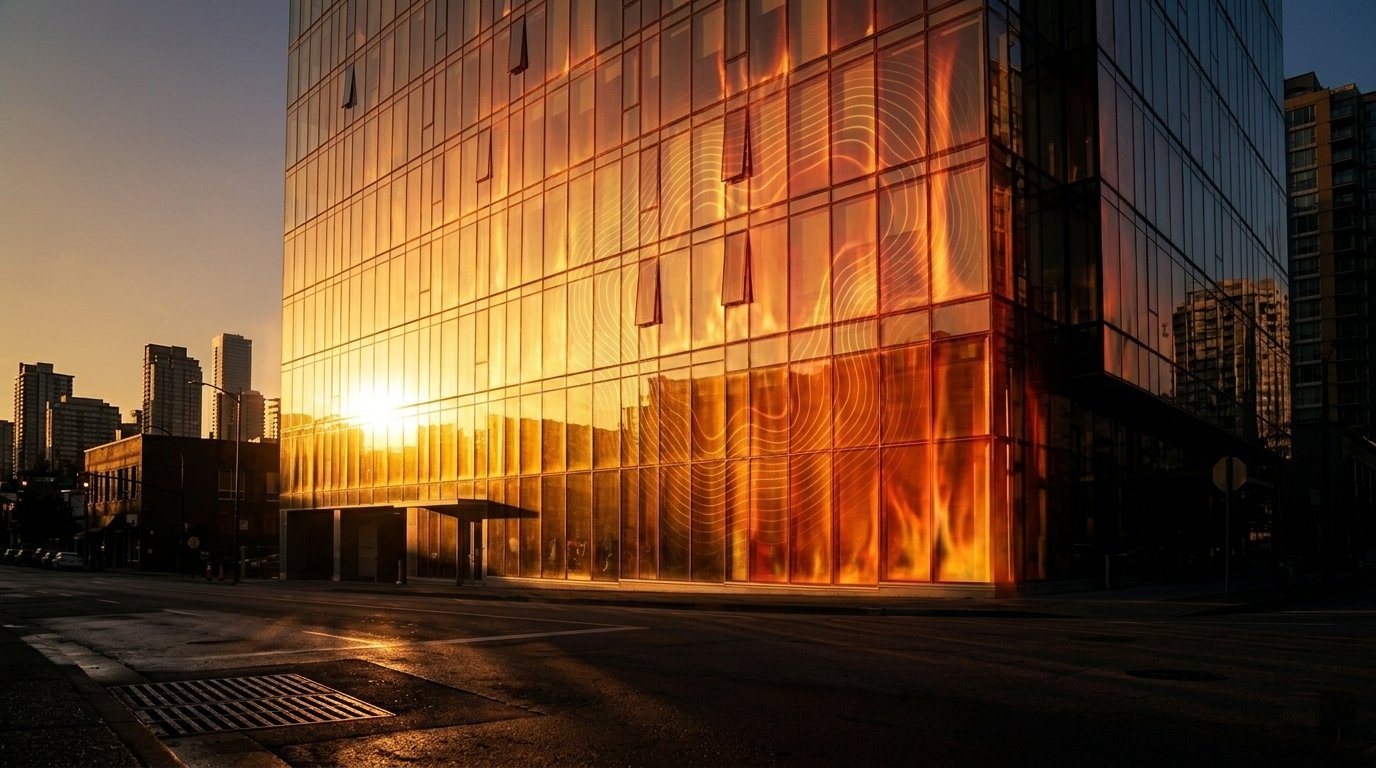
A window is a hole in the wall that we’ve been fighting with ever since we invented it.
It lets in light. That’s what we want. But it also lets in heat, ultraviolet radiation, and glare. So we add blinds to block the glare. Tints to reduce the UV. Low-E coatings to bounce some heat. And then air conditioning to deal with whatever got through anyway.
Energy fighting energy. Mechanical systems compensating for a surface that can’t sort. In commercial buildings, windows are the single largest driver of cooling load. The glass doesn’t manage light. It surrenders to it.
Glass is transparent. That’s the whole problem.
Glass transmits visible light — wavelengths between about 400 and 700 nanometres. That’s what makes it useful. But it also transmits near-infrared — wavelengths from 700 to about 2500 nanometres. That’s heat. Solar radiation pouring through the glass, warming everything it touches.
And it transmits UV — wavelengths below 400 nanometres. That’s what fades the furniture, degrades the flooring, and damages skin. A window lets in everything and sorts nothing.
Visible light, infrared heat, and ultraviolet radiation aren’t three separate problems. They’re three regions of the same spectrum. A surface that could sort by wavelength would solve all of them at once.
The structural dye stack, applied to glass.
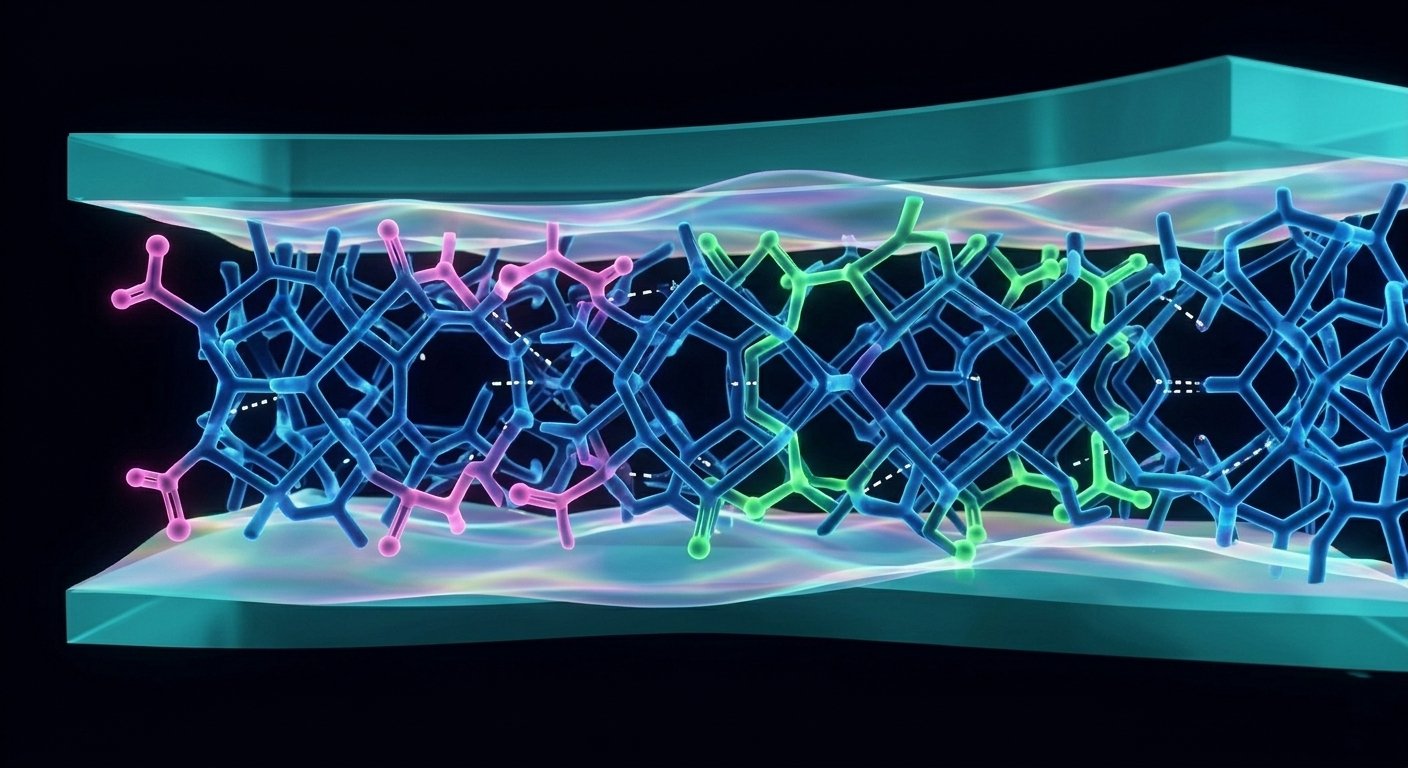
The same modular architecture that produces structural colour can manage the full solar spectrum. A UV-absorbing layer handles the short wavelengths. A visible-transmitting structural layer lets light through with controlled colour rendering. An IR-rejecting layer reflects heat.
Each layer is attached with orthogonal chemistry — the same attachment system as the structural dye stack, the same system as the molecular capture mesh. Each layer handles its region of the spectrum independently. None interferes with the others.
One surface. Three functions. No mechanical parts. No energy consumed.
Interactive
What gets through
No layers — everything gets through.
Inside vs outside is a different energy landscape.
Place the IR-rejecting layer on the outside of the glass, and it intercepts solar heat before it enters. The glass stays cool. The room stays cool. Maximum effect.
Place it on the inside, and it only catches what the glass re-emits after absorbing solar IR itself. The glass heats up. It radiates inward. The layer catches some of that, but the spectrum has already changed — it’s no longer direct solar IR, it’s thermal emission from warm glass. Different wavelengths, different physics, lower efficiency.
Same modules, different arrangement, different outcome. The position is a design variable — and the calculation tells you which position to choose.
Interactive
Sunlight
Room
Stack
Glass
Glass stays cool
IR blocked
85%
Glass temp
28°C
Efficiency
High
Exterior: IR rejected before it enters the glass. Glass stays cool. Maximum effect.
Solar heat and room heat are different spectral regions. A designed surface can treat them independently.
Solar near-IR peaks around 800–1500 nanometres. That’s the heat pouring through the window on a summer afternoon. Room-temperature thermal radiation — what your furniture and walls emit — peaks around 10,000 nanometres, far out in the mid-infrared.
A surface tuned to reject solar near-IR doesn’t need to interact with room-temperature IR at all. And a surface designed to retain room heat in winter can be transparent to solar near-IR, letting the sun warm the building passively.
Different problems, different spectral regions, same modular architecture.
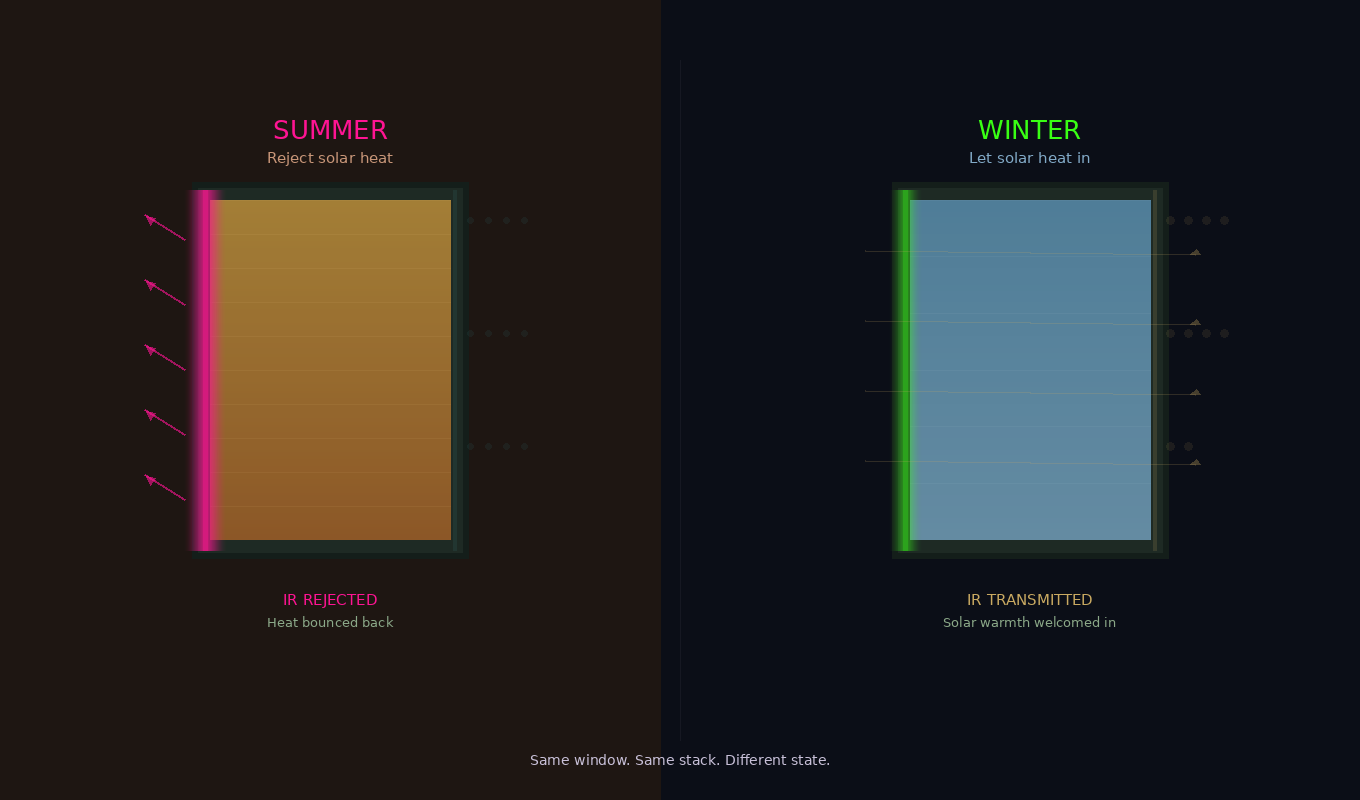
Summer: reject solar heat. Winter: let it in. Same window.
Field-responsive materials change their optical properties with an electrical or magnetic signal. An IR-rejecting layer that becomes IR-transparent when you flip a switch. Summer mode blocks the heat. Winter mode welcomes it.
The modular stack makes this possible because each layer is independent. Switching the IR layer doesn’t affect the UV layer or the visible transmission. Orthogonal functions, orthogonal control.
Interactive
What gets through
Summer: UV blocked, visible transmitted, IR rejected. The room stays cool.
Same surface. Same stack. One layer changed state.
The surface does the work. The physics is the mechanism.
No blinds to adjust. No tints to degrade. No mechanical systems to maintain. No energy consumed to manage energy. The coating is applied once — solution-phase chemistry at ambient conditions, the same deployment method as the structural dyes — and it works for the life of the glass.
This isn’t a smart window that needs a power supply and a control system. It’s a surface whose molecular structure sorts photons. Passive thermal management from the physics of the coating itself.
A window that sorts photons. A cage that sorts molecules. A dye that sorts colours. A surface that sorts binders.
Four problems. Four scales. Four industries. One continuous interaction space — computing how fields interact in confined geometries. The same engine. The same physics. The same platform.
These are all trajectories on the same energy surface. The engine that finds them is called MABE.
Meet the foundry →