Explore
Where does colour come from?
Your red shirt is red because the dye molecules in the fabric are eating every colour of light except red.
That’s how conventional dyes work. A molecule absorbs photons at specific wavelengths — the energies that match its electronic structure get swallowed. Everything else bounces back to your eyes. The colour you see is whatever the dye didn’t eat.
It works. It’s been working since humans ground up beetles and boiled plants for pigment. But it’s not the only way to make colour.
Interactive
Dye
Incoming light
What you see
Absorption across the spectrum
Blue and green absorbed. Red and orange survive. You see a red dye.
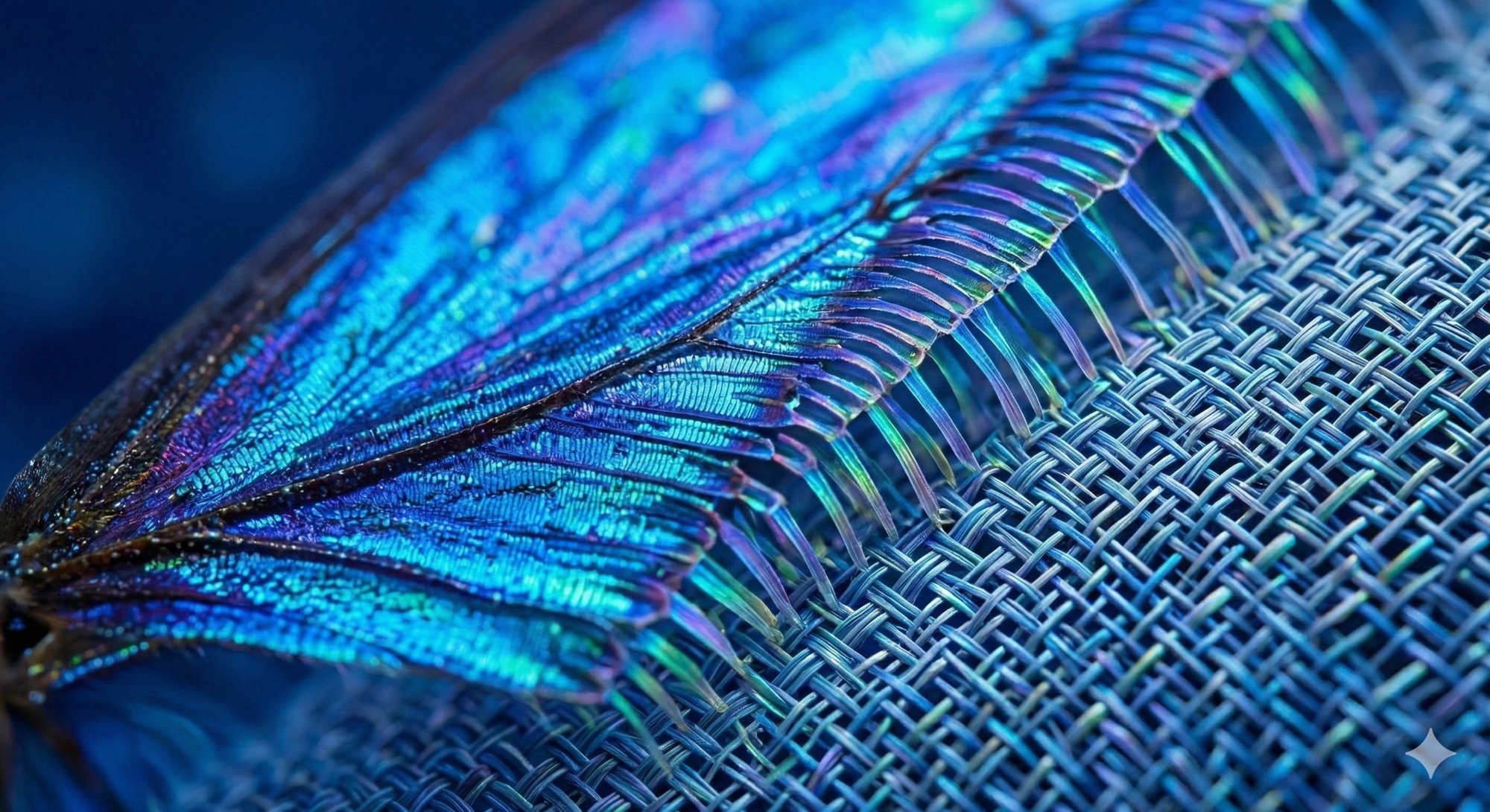
A Morpho butterfly wing is blue. There is no blue pigment anywhere in it.
The blue comes from structure — layers of material spaced at just the right distance apart. When light enters the wing, it bounces between these layers. Most wavelengths cancel themselves out, interfering destructively. But blue light — with a wavelength that matches the spacing — reinforces itself. Constructive interference. The blue gets louder. Everything else goes quiet.
No molecule was consumed. No photon was eaten. The colour is geometry — the physical arrangement of matter at the nanoscale, sorting light by wavelength.
This is structural colour. And it never fades, because there’s no pigment to break down. The structure persists. The colour persists.
Interactive
Peak wavelength
464 nm
Reflected colour
nₑᶠᶠ
1.45
Where on the spectrum
Spacing of 160 nm reinforces blue. Everything else cancels.
Blue and green are easy. Red is a problem.
To get structural red, you need bigger particles — spaced further apart to match red’s longer wavelength. But when particles get that big, something else happens. They start scattering light on their own, independently of the structure. Mie scattering. And it scatters preferentially into the blue.
So you have two things competing: the structural interference pushing toward red, and the individual particle scattering flooding the blue channel. The result? Muddy purple. Not red.
This isn’t a manufacturing problem. It’s physics. Nature ran into the same wall — there are almost no red structural colours in the natural world. Beetles, birds, butterflies: blues and greens everywhere. Red? Almost never.
The red problem forced a different approach. And that different approach opened something much bigger.
Interactive
Structural peak
403 nm
Mie backscatter
Weak
You see
Small particles. Clean structural blue. Mie scattering is negligible.
Same core. Different shell. Different colour.
Instead of making bigger particles, you wrap the same particle in a molecular shell. The shell changes two things: the refractive index — how much it bends light — and the absorption — which wavelengths it quietly removes.
Different shells have different electronic structures. A copper-coordinating nitrogen chelator absorbs at one wavelength. A lead-based shell bends light more — its lone electron pair makes it far more polarisable — but absorbs nothing. Each shell has a different conversation with light, starting from the same core.
We call these structural dyes. Modular molecular shells on commodity particle cores, each one a programmable optical layer. The core is the scaffold. The shell is the design variable. The colour is the outcome of the physics between them.
Not a pigment that eats light. A structure that sorts it. And the shell determines the sorting.
Interactive
Predicted colour
Reflectance
Bare silica core. Structural colour from spacing alone.
Same core. Different shell. Different colour.
What you reject matters as much as what you accept.
Beneath the structural dye layer sits a primer — a thin coating of hematite, iron oxide. It’s not just glue. The primer has its own wavelength-dependent reflectance. It selectively recycles transmitted light, bouncing certain wavelengths back up through the structure for a second pass.
This is spectral shaping. The primer suppresses the noise — the unwanted blue scatter that made the red problem insoluble — and amplifies the signal. It’s not adding colour. It’s removing what shouldn’t be there.
The primer is designing the rejection. And that turns out to be a general principle.
Each layer clicks in independently. That’s not an accident.
The chemistry holding these layers together is orthogonal — each attachment is independent of the others. The primer bonds to the substrate through one mechanism. The structural dye particles bond to the primer through another. Neither interferes with the other. Neither requires the other to go first.
This wasn’t the original goal. The red problem forced cooperating layers. Cooperating layers forced orthogonal attachment. And orthogonal attachment created a modular architecture that can grow.
Colour was the first problem this architecture solved. But the same stack can manage UV. The same stack can manage heat. Add a layer, add a function — each one independent, all of them cooperating. The architecture was designed by the physics of the problem itself.
Interactive
What gets through
No layers — everything gets through.
The orthogonal chemistry holding those layers together — it works for more than light.
A structural dye sorts photons by designing the surface they interact with. What happens when you design a surface to grab a molecule instead of a photon? What happens when the target isn’t light — but a toxin washing off a road in the rain?
When it rains, what’s killing the salmon? →