
Explore
Why does a drug cost $40,000?
$40,000 for a single dose. Not because binding is hard. Because of everything around the binding.
A monoclonal antibody is one of the most effective tools in modern medicine. It binds a specific target on a specific cell with extraordinary selectivity. It can shut down a cancer receptor, neutralise a virus, calm an autoimmune cascade.
The binding itself is elegant. The pipeline that gets it into your arm is not. The $40,000 is death by a thousand cuts — and every cut exists because each step treats binding as biology.
It grabs one thing and ignores everything else.
That’s the whole job. An antibody is a selective binder. It recognises a specific molecular surface — a few square nanometres of shape, charge, and polarity — and grips it tightly enough to trigger a biological response.
The selectivity is astonishing. Among millions of molecules in the bloodstream, the antibody finds its one target. The question is how we find the antibody.
Inject an animal. Wait. Hope its immune system cooperates.
You inject a mouse — or a rabbit, or a llama — with the target molecule. Its immune system responds by producing antibodies. Thousands of different B cells, each making a slightly different antibody, each one a guess at what might bind the target.
After weeks, you sacrifice the animal and harvest its spleen. Millions of B cells. Somewhere in there are the handful making the right antibody. You just don’t know which ones.
A $500,000 machine sorting millions of cells per second. Most of what it finds won’t work.
Flow cytometry. Cells pass through a laser beam in single file. Each cell scatters light differently. Each cell is labelled with fluorescent markers. The machine reads the scatter and the fluorescence and decides — in microseconds — whether to keep or discard each cell.
It runs for days. It costs thousands per run. And it’s brute force — you’re sorting by proxy markers, not by binding quality. The cells it selects are candidates, not answers.
B cells wear a sugar coat. It’s a molecular address.
Every B cell displays glycans on its surface — complex sugar molecules arranged in patterns that vary by cell type, activation state, and what antibody the cell is producing. The glycan signature is an identity tag. And it’s accessible from the outside.
If you can design a surface that selectively binds the glycan signature of the B cells you want, you don’t need a flow sorter at all. Pour the spleen cells over the surface. The ones you want stick. Everything else washes away. Pull-down instead of brute-force sorting.
The problem is that glycan-lectin binding — how sugars interact with their receptors — is a prediction problem that no commercial software solves. The physics is complex: hydrogen bonding networks in water, ring conformations, multivalent contacts.
The same engine that designed the molecular cage for 6PPD-quinone scores glycan-lectin binding. R² = 0.991 across 22 validated interactions. Same equation. No re-parameterisation.
Rounds of experiments measuring what physics already knows.
You have candidates. Now you test them. Does it bind tightly enough? Surface plasmon resonance — days, thousands of dollars. Does it bind the right part of the target? Epitope mapping — weeks. Does it cross-react with things it shouldn’t? Selectivity panels — months. Most candidates fail. You go back to the animal.
Each of these experiments is measuring a physical quantity — how strongly two surfaces interact in water. It’s the same calculation the engine runs for every other binding problem. ΔG = Vpocket(r) − Vsolvent(r). Two interacting fields. One equation.
Triage computationally. Only test the winners.
The engine scores protein-ligand binding from zero training data. No parameters fitted to binding affinities. Every parameter traces to gas-phase quantum chemistry or atomic properties. It scored a 58-residue protein binding a serine protease to 0.03 pK accuracy — using the same parameters as every small-molecule prediction. No re-fitting.
Run the candidates through the engine before you run them through the lab. Discard the ones that won’t work. Test only the ones the physics says should bind. Months of experiments become hours of computation.

This is where the real money lives.
The antibody that survived finding, sorting, and testing now has to be manufactured. In living cells. Chinese hamster ovary cells, growing in stainless steel bioreactors, temperature-controlled, sterile, monitored constantly. The protein folds or it doesn’t. The yield varies batch to batch.
Then cold chain from factory to clinic. Never above 8°C. Specialised packaging, specialised logistics, specialised storage at the hospital. Every link in the chain adds cost because the product is fragile. It’s a protein. It denatures.
Biology manufacturing biology. And biology doesn’t scale like chemistry.
If binding is physics, the molecule doing the binding doesn’t have to be biological.
Compute the binding surface of the target. Design a synthetic molecule that presents the complementary shape, charge, and polarity. Manufacture it with chemical synthesis — in a flask, at room temperature, with reagents that cost dollars per gram.
No animals. No cell lines. No bioreactors. No cold chain. Chemical manufacturing scales. The cost drops not because the science gets cheaper, but because the manufacturing becomes chemistry instead of biology.
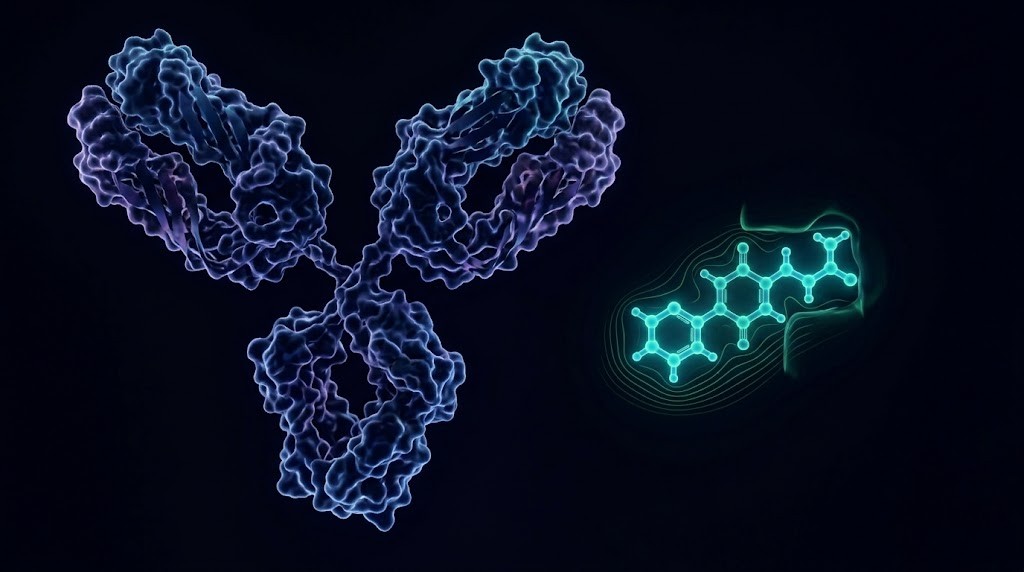
Every step exists because the previous one was biological. Replace the biology with physics at any step, the cost drops.
Replace the flow sorter with a designed glycan pull-down surface. Replace rounds of binding assays with computed triage. Replace the protein binder with a synthetic molecule. Replace the bioreactor with a round-bottom flask.
Replace it at one step and the number shrinks. Replace it at every step and the number changes entirely.
Interactive
0/4 steps replaced
The full biological pipeline. $40,000 a dose.
The same physics that designs a binder for a cell surface designs a surface for a building.
An antibody grabs a receptor. A cage grabs a toxin. A structural dye sorts photons. What happens when the target isn’t a molecule or a photon — but sunlight pouring through a window?
What if buildings could breathe? →